
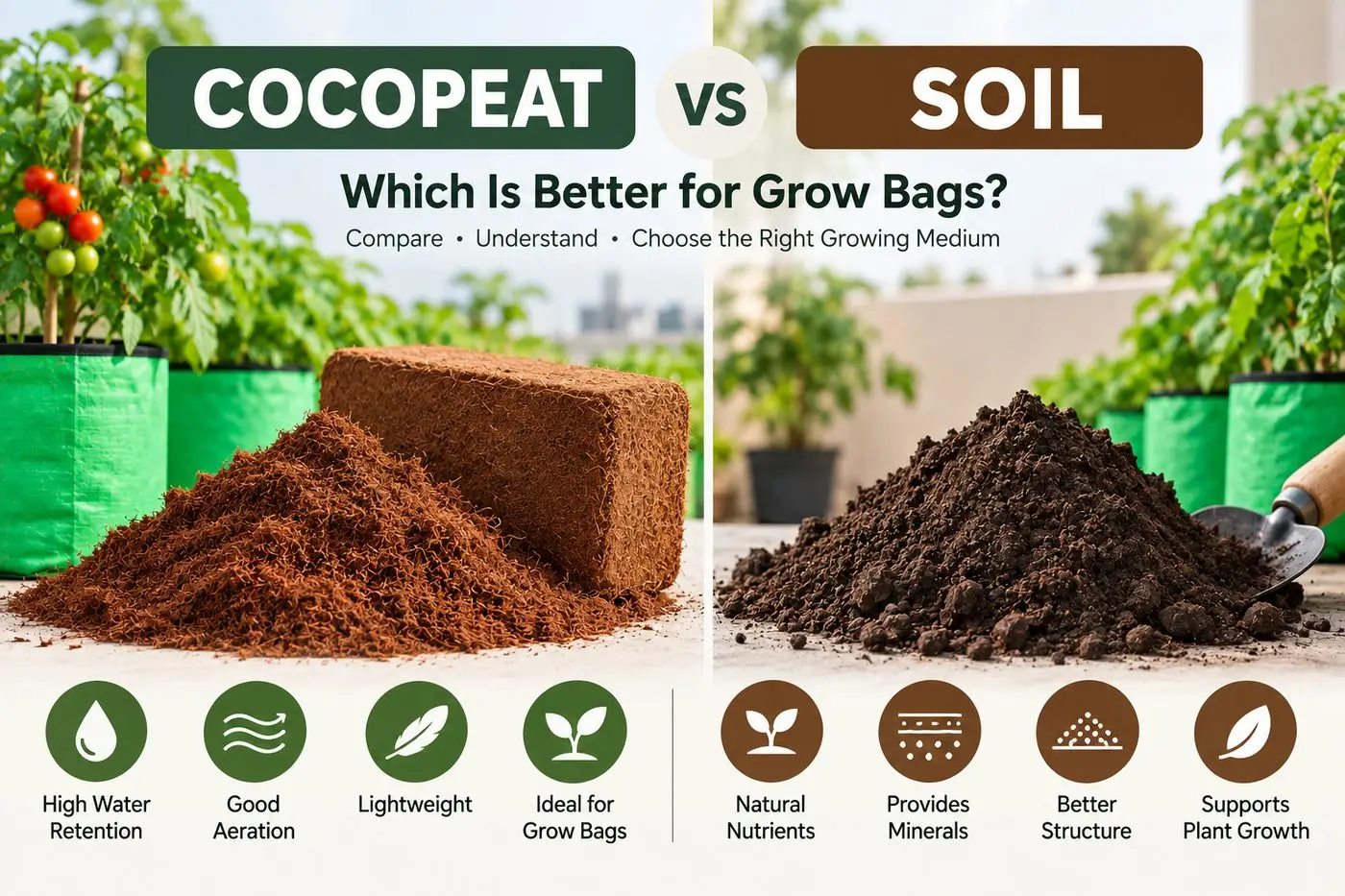
When growing vegetables in grow bags, one of the first questions gardeners ask is: Should I use cocopeat or soil?
Both cocopeat and soil have important roles in plant growth, but they work differently. Soil provides minerals and nutrients, while cocopeat is mainly valued for its water-holding capacity, aeration, and lightweight structure.
So, which one is better for grow bags?
The answer depends on the crop, growing conditions, watering practices, and the type of growing medium you want to create.
In this guide, we'll compare cocopeat vs soil and explain how you can use them effectively for vegetable gardening, terrace gardens, nurseries, and container farming.
Cocopeat vs Soil at a Glance
| Feature | Cocopeat | Soil |
|---|---|---|
| Weight | Lightweight | Heavy |
| Water retention | High | Varies |
| Aeration | Generally good | Depends on soil structure |
| Drainage | Good when properly prepared | Varies |
| Nutrient content | Low by itself | Naturally contains minerals and nutrients |
| Organic matter | Limited by itself | Depends on soil |
| Root environment | Loose and airy | Can become compact |
| Suitable for grow bags | Excellent as a growing-medium component | Yes |
| Terrace gardening | Very suitable | Can be heavy |
| Reusable | Can be reused with proper management | Usually replaced/amended |
| Best use | Growing-medium component | Nutrient and mineral base |
What Is Cocopeat?
Cocopeat is a growing medium made from processed coconut husk fibers and pith. It is widely used in container gardening, nurseries, greenhouse cultivation, hydroponics, and grow-bag farming.
Its biggest advantages are its ability to:
- Hold moisture
- Maintain air spaces around roots
- Keep growing media relatively lightweight
- Support root development
- Improve the structure of growing mixes
Cocopeat is particularly useful where traditional garden soil is too heavy or compact for container gardening.
However, cocopeat alone should not automatically be considered a complete nutrient source. Plants still require essential nutrients, so fertilization or other nutrient-rich components may be necessary.
What Is Soil?
Soil is a natural growing medium consisting of mineral particles, organic matter, water, air, and living organisms.
Garden soil can provide plants with:
- Minerals
- Nutrients
- Organic matter
- Microorganisms
- Physical support
However, not all soil is suitable for grow bags.
Heavy clay soil, for example, can become compact and may restrict drainage and root aeration. This is particularly important in containers because roots have much less space than they do in open ground.
Cocopeat vs Soil: Which Holds More Water?
Cocopeat is known for its strong moisture-holding ability.
It can absorb and retain water while still maintaining air spaces within the growing medium when properly prepared.
Soil behaves differently depending on its composition.
Sandy soil may drain quickly, while clay-heavy soil may retain water for longer and become compact.
Winner: Cocopeat for consistent moisture management
However, more water retention isn't always better. Plants need both moisture and oxygen around their roots.
The goal is to create a growing medium that retains enough moisture without becoming waterlogged.
Which Provides Better Aeration?
Root systems require oxygen for healthy development.
A compact growing medium can reduce air spaces and make it harder for roots to access oxygen.
Cocopeat generally provides a loose structure that can help maintain air spaces around the root zone.
Soil can also provide good aeration when it has a suitable structure, but heavy or compacted soil may restrict airflow.
Winner: Cocopeat
This is one reason cocopeat is popular in container gardening.
Which Provides More Nutrients?
This is where soil has a major advantage.
Natural soil can contain minerals and organic matter that contribute to plant nutrition.
Cocopeat itself is not a complete fertilizer.
Although it provides an excellent physical environment for roots, plants still need nutrients such as nitrogen, phosphorus, potassium, calcium, magnesium, and other micronutrients.
Therefore, if you're using cocopeat as a major component of your growing medium, you should provide nutrients through suitable compost, organic manure, fertilizers, or other amendments according to the crop's requirements.
Winner: Soil for naturally available nutrients
Is Cocopeat Better Than Soil for Grow Bags?
For many grow-bag applications, a combination of materials can be better than using either cocopeat or soil alone.
A balanced growing medium can combine:
- Soil for mineral content and structure
- Cocopeat for moisture retention and aeration
- Vermicompost or compost for organic matter and nutrients
The exact proportions should depend on the crop and local conditions rather than following one universal recipe.
For example, a gardener growing tomatoes may require a different growing medium from someone growing coriander or spinach.
Cocopeat vs Soil for Terrace Gardening
Terrace gardening has a unique challenge: weight.
Large quantities of wet soil can place considerable load on a terrace.
Cocopeat is significantly lighter than traditional garden soil, making it useful when designing container-growing systems.
However, terrace gardeners should still consider the total load of:
- Containers
- Growing medium
- Water
- Plants
- Stands
- Other gardening equipment
If you're setting up a large terrace garden, check the structural capacity of the terrace and seek professional advice where appropriate.
For lightweight growing media: Cocopeat has a major advantage.
Can You Grow Plants in 100% Cocopeat?
Plants can be grown in cocopeat-based systems, but cocopeat should not be treated as a complete source of plant nutrition.
If you're using mostly or entirely cocopeat, you'll need to manage plant nutrition carefully through an appropriate nutrient program.
For simple home vegetable gardening, combining cocopeat with nutrient-rich organic materials can be more convenient.
Can You Grow Plants in 100% Soil?
Yes.
Vegetables can be successfully grown in soil-filled containers when the soil has suitable structure, drainage, fertility, and moisture management.
The problem occurs when gardeners simply take heavy garden soil and place it into a grow bag.
Compacted soil can cause:
- Poor drainage
- Reduced aeration
- Root restriction
- Waterlogging
- Poor plant growth
This is why improving the structure of the growing medium is important.
Cocopeat + Soil + Vermicompost: A Practical Combination
For many home gardeners, combining different materials can provide a more balanced growing environment.
Cocopeat
Helps with:
- Moisture retention
- Aeration
- Lightweight structure
Soil
Provides:
- Mineral content
- Physical support
- Natural microorganisms
Vermicompost
Provides:
- Organic matter
- Nutrients
- Improved growing-medium fertility
Together, these materials can create a practical growing medium for many container-grown vegetables.
The exact ratio should be adjusted based on the crop, climate, watering frequency, and quality of the materials.
Which Is Better for Different Vegetables?
Tomatoes
Tomatoes need substantial root space and good drainage.
Recommended approach: A well-draining mix containing soil, cocopeat, and organic compost or vermicompost.
Chillies
Chilli plants can perform well in a lightweight, well-aerated growing medium.
Recommended approach: Cocopeat combined with soil and organic nutrient sources.
Cucumber
Cucumber grows quickly and requires consistent moisture.
Recommended approach: A moisture-retentive but well-draining growing medium containing cocopeat.
Leafy Vegetables
Spinach, coriander, and similar crops have relatively shallow root systems.
Recommended approach: A light, fertile growing medium with good moisture retention.
Common Mistakes When Using Cocopeat
1. Assuming Cocopeat Contains Everything Plants Need
Cocopeat is primarily a growing-medium component, not a complete fertilizer.
2. Using Poor-Quality Cocopeat
Quality and preparation matter. Depending on the source and processing, cocopeat may require appropriate washing, buffering, or preparation before use.
3. Overwatering
Because cocopeat retains moisture, watering should be based on actual moisture conditions rather than a fixed schedule.
4. Ignoring Drainage
Even a good growing medium can become problematic if the grow bag does not drain properly.
5. Using Too Much Nutrient Material
Adding excessive fertilizer or manure can also harm plants.
How to Choose Cocopeat for Grow Bags
Before purchasing cocopeat, consider:
Quality
Choose clean, properly processed cocopeat suitable for plant cultivation.
Moisture and Expansion
Compressed cocopeat can expand considerably when hydrated, so understand the expected expansion before purchasing.
Salt Content
Depending on its source and processing, cocopeat can contain soluble salts. Properly processed material is important for sensitive crops.
Packaging
For home gardens, smaller packs may be convenient. Commercial growers may prefer bulk quantities.
Intended Use
Cocopeat requirements can differ between seed starting, container gardening, nursery production, and hydroponic applications.
Cocopeat vs Soil: Final Verdict
So, which is better — cocopeat or soil?
Neither is universally better.
Soil provides minerals, nutrients, and physical support, but it can become heavy and compact when used in containers.
Cocopeat provides excellent moisture management, aeration, and a lightweight structure, but it does not provide complete nutrition on its own.
For many vegetable gardens, particularly grow-bag and terrace gardens, a properly prepared combination of cocopeat, suitable soil, and organic nutrient sources can provide a more balanced growing environment.
The most important factors are not simply the ingredients, but the final growing medium's:
- Drainage
- Aeration
- Moisture retention
- Nutrient availability
- Structure
- Suitability for the crop
Looking for Cocopeat and Growing Materials?
Samarth Organics provides cocopeat, vermicompost, HDPE grow bags, and other growing materials for home gardeners, farmers, nurseries, and commercial growers.
Whether you're setting up a small terrace garden or planning a larger cultivation project, choosing the right growing medium is an important first step.
Need help choosing the right combination of grow bags and growing media? Contact Samarth Organics with the crop you want to grow and your growing setup.
Frequently Asked Questions
Is cocopeat better than soil for grow bags?
Cocopeat has advantages such as moisture retention, aeration, and low weight. Soil provides minerals and physical support. For many grow-bag applications, combining cocopeat with suitable soil and organic nutrient sources can be more practical than using either one alone.
Can I mix cocopeat with soil?
Yes. Cocopeat can be mixed with suitable soil to improve moisture retention and aeration in a growing medium.
Can plants grow only in cocopeat?
Yes, plants can be grown in cocopeat-based systems, but nutrients must be supplied because cocopeat alone is not a complete fertilizer.
Is cocopeat good for terrace gardening?
Yes. Its lightweight nature and moisture-retention properties make cocopeat useful for terrace and container gardening.
Does cocopeat contain nutrients?
Cocopeat is primarily used for its physical properties rather than as a complete nutrient source. Plants generally require additional nutrition.
What is the best growing medium for vegetables?
There is no single best mix for every vegetable. The ideal growing medium depends on the crop, climate, container size, drainage, watering, and nutrient requirements.
Can I use vermicompost with cocopeat?
Yes. Vermicompost can be incorporated into a cocopeat-based growing medium to provide organic matter and nutrients.