
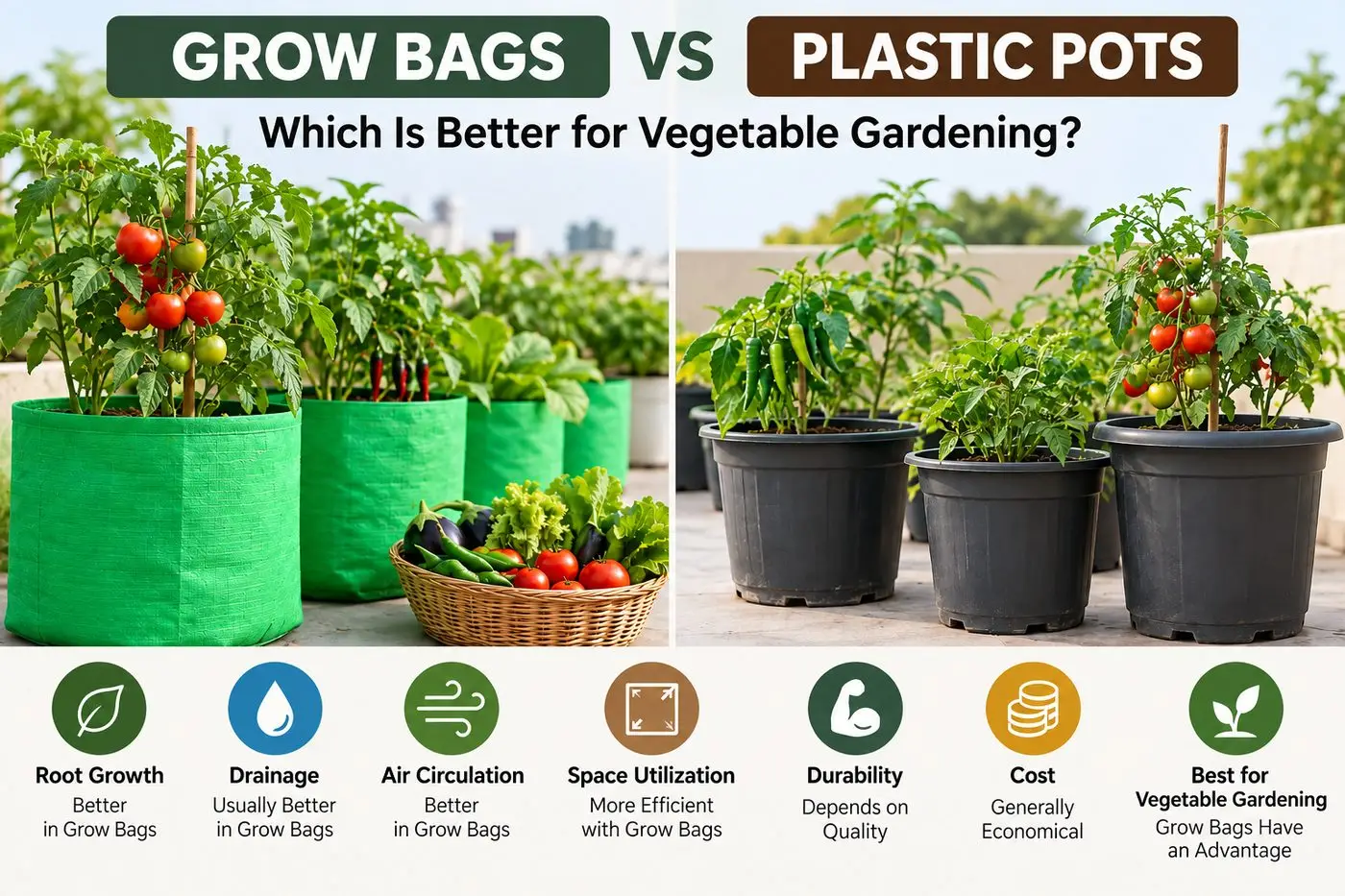
Grow Bags vs Plastic Pots is a common question among home gardeners, terrace gardeners, nursery owners, and vegetable growers. Both options can be used to grow vegetables successfully, but they differ in drainage, root growth, portability, space utilization, durability, and overall growing conditions.
If you're planning a terrace garden or growing vegetables in a limited space, choosing the right container can make a significant difference.
In this guide, we'll compare grow bags and plastic pots and help you decide which option is better for your vegetable garden.
Grow Bags vs Plastic Pots at a Glance
| Feature | Grow Bags | Plastic Pots |
|---|---|---|
| Root development | Excellent | Good |
| Drainage | Usually excellent with proper holes | Depends on pot design |
| Air circulation around roots | Better | Limited |
| Space utilization | Excellent | Moderate |
| Portability | Easy to move when empty; heavier when filled | Easy to move |
| Storage | Easy to fold and store | Requires more storage space |
| Vegetable gardening | Excellent | Good |
| Terrace gardening | Excellent | Good |
| Large-scale growing | Very suitable | Less convenient |
| Durability | Depends on material and quality | Generally good |
| Cost | Generally economical | Varies by size and quality |
What Are Grow Bags?
Grow bags are flexible containers designed specifically for growing plants without directly planting them in the ground. They are commonly made from materials such as HDPE, woven fabric, or other durable materials.
They are available in different sizes, allowing gardeners to select a suitable container according to the crop and root system.
For vegetable gardening, grow bags can be used for crops such as:
- Tomato
- Chilli
- Capsicum
- Brinjal
- Cucumber
- Okra
- Spinach
- Coriander
- Leafy vegetables
- Strawberries
One of the major advantages of grow bags is their ability to provide a practical growing space where traditional gardening is difficult, such as terraces, balconies, and small outdoor areas.
What Are Plastic Pots?
Plastic pots are rigid containers commonly used for growing ornamental plants, flowers, herbs, and vegetables.
They are available in many shapes and sizes and are widely used in:
- Home gardens
- Balconies
- Nurseries
- Terraces
- Indoor and outdoor gardening
Plastic pots are easy to clean, reusable, and available in different sizes. However, their performance depends heavily on the number and placement of drainage holes.
Grow Bags vs Plastic Pots: Detailed Comparison
1. Root Growth
One of the biggest differences between grow bags and plastic pots is how they affect root development.
In a traditional plastic pot, roots can continue growing until they reach the sides or bottom of the container. Depending on the plant and pot design, this can contribute to root circling.
Many grow bags provide a more breathable growing environment. In suitable grow bags, roots reaching the sides can encounter a combination of air exposure and limited space, which can encourage branching rather than continued circling.
For vegetable plants with active root systems, a good-quality grow bag can therefore be an excellent option.
2. Drainage
Vegetable plants need sufficient moisture, but excess water around the roots can create problems.
Grow bags typically have drainage throughout the base and, depending on their construction, may allow excess water to escape efficiently.
Plastic pots can also provide excellent drainage when properly designed, but poorly positioned or insufficient drainage holes can cause water to remain in the growing medium.
Winner: Grow Bags
However, the growing medium and drainage-hole design matter more than the container type alone.
3. Air Circulation Around the Roots
Roots require oxygen as well as water and nutrients.
A flexible, breathable grow bag can provide better air exchange around the root zone than some conventional plastic containers.
This can be particularly useful when growing vegetables in containers because healthy roots support healthy above-ground growth.
Plastic pots are less breathable because their walls are generally non-porous.
Winner: Grow Bags
4. Space Utilization
If you have a small terrace or balcony, space can become a major concern.
Grow bags are flexible and can be placed relatively close together while still allowing plants enough room for growth. They can also be folded and stored when not being used.
Plastic pots occupy a fixed shape and usually require more storage space when many containers are involved.
Winner: Grow Bags
5. Portability
Plastic pots are rigid and relatively easy to move when they contain small plants.
Grow bags are also easy to reposition, particularly before filling them with growing media. Once filled with soil, cocopeat, compost, and a mature plant, however, larger grow bags can become heavy.
For this reason, it's better to decide the final position before filling a large grow bag.
Winner: Depends on size
For small plants, both work well. For large plants, moving either container after filling can be difficult.
6. Durability
The durability of either option depends heavily on product quality, thickness, material, UV resistance, handling, and exposure to weather.
A high-quality HDPE grow bag can be designed for outdoor agricultural and gardening applications and can provide good durability when used and maintained correctly.
Plastic pots can also last for years, especially when made from durable plastic and protected from excessive physical damage and sunlight.
Winner: Depends on quality
Don't choose a container only because it is cheaper. For outdoor vegetable gardening, material quality and construction are important.
7. Water Management
The container is only one part of the equation.
Your watering frequency should depend on:
- Crop
- Weather
- Container size
- Growing medium
- Plant size
- Drainage
- Sunlight
- Humidity
A grow bag containing a cocopeat-based growing medium may behave very differently from a plastic pot filled with garden soil.
Therefore, don't follow the same watering schedule for every container.
Check the moisture of the growing medium and water according to the plant's requirements.
8. Which Is Better for Terrace Gardening?
For terrace gardening, grow bags are often an attractive option because they are lightweight when empty, easy to arrange, available in many sizes, and suitable for growing a wide range of vegetables.
They are particularly useful when you want to create a vegetable garden without constructing permanent beds.
Plastic pots are also suitable for terrace gardening, especially for herbs, flowers, smaller vegetables, and individual plants.
For a vegetable-focused terrace garden, grow bags generally have an advantage.
9. Which Is Better for Different Vegetables?
The right container size is more important than simply choosing between grow bags and pots.
Tomatoes
Tomatoes require sufficient root space and support.
Good option: Large grow bag or large plastic pot.
Chillies
Chilli plants can grow successfully in medium-sized containers.
Good option: Grow bag or plastic pot.
Brinjal
Brinjal develops into a relatively large plant.
Good option: Medium to large grow bag or pot.
Cucumber
Cucumber needs sufficient root space and vertical support.
Good option: Large grow bag with trellis/support.
Leafy Vegetables
Spinach, coriander, and other leafy vegetables generally require less root depth.
Good option: Smaller grow bags, trays, or shallow containers.
10. Grow Bags vs Plastic Pots: Which Should You Choose?
There is no single container that is perfect for every gardener.
Choose grow bags if you:
- Want to grow vegetables on a terrace
- Have limited gardening space
- Want flexible container sizes
- Want an easy-to-store container
- Plan to grow multiple vegetables
- Need containers for larger vegetable plants
- Want a practical option for container farming
Choose plastic pots if you:
- Prefer rigid containers
- Are growing ornamental plants
- Need containers for small herbs or plants
- Already have suitable pots
- Prefer traditional container gardening
For a dedicated vegetable garden, especially on a terrace or in a limited space, quality grow bags can offer several practical advantages.
What Should You Look for When Buying Grow Bags?
Not all grow bags are the same.
Before purchasing, consider:
1. Material Quality
Look for a strong material suitable for outdoor use.
2. Size
Choose the size according to the crop's root requirements.
3. Stitching and Construction
For fabric or woven bags, strong stitching can improve durability.
4. Drainage
Proper drainage is essential for healthy roots.
5. Handles
Strong handles make it easier to move the grow bag when necessary.
6. UV Resistance
For outdoor gardening, UV-resistant material can help improve durability under sunlight.
7. Thickness and Load Capacity
Large plants and wet growing media can place considerable stress on the container.
Can You Use Cocopeat and Vermicompost in Grow Bags?
Yes. Grow bags can be filled with different growing media depending on the crop and cultivation method.
A growing mix may include combinations of:
- Soil
- Cocopeat
- Vermicompost
- Compost
- Other suitable amendments
The exact mixture should be selected according to the crop, drainage requirements, nutrient requirements, and local growing conditions.
For gardeners looking to improve moisture management while maintaining good aeration, cocopeat can be a useful component of a growing medium.
Vermicompost can also be incorporated as an organic nutrient source.
Grow Bags or Plastic Pots: The Final Verdict
So, which is better for vegetable gardening — grow bags or plastic pots?
Both can produce healthy plants when the container size, growing medium, drainage, watering, sunlight, and nutrition are managed correctly.
However, grow bags are often the more practical choice for vegetable gardening, terrace gardens, and space-efficient cultivation because they offer flexible sizing, convenient storage, and good growing conditions when properly designed and used.
Plastic pots remain a reliable choice, particularly for smaller plants, herbs, flowers, and gardeners who prefer rigid containers.
Ultimately, the best choice depends on your crop, available space, budget, and gardening goals.
Looking for Quality Grow Bags?
If you're planning a terrace garden, home vegetable garden, nursery, or larger growing setup, choosing the right grow bag can make your cultivation process easier.
Samarth Organics provides HDPE grow bags and other growing materials for gardeners, farmers, nurseries, and growers.
Explore our range of grow bags, cocopeat, vermicompost, and growing solutions to find materials suitable for your cultivation needs.
Have questions about choosing the right grow bag size? Contact Samarth Organics and tell us what you plan to grow. We can help you choose a suitable option.
Frequently Asked Questions
Are grow bags better than plastic pots?
For many vegetable-growing applications, grow bags offer practical advantages such as flexible sizing, convenient storage, and good root-zone conditions. However, both grow bags and plastic pots can grow vegetables successfully when properly managed.
Which is better for terrace gardening: grow bags or pots?
Grow bags are often preferred for terrace vegetable gardens because they are flexible, available in different sizes, and convenient for growing multiple crops in limited spaces.
Do vegetables grow well in grow bags?
Yes. Many vegetables, including tomatoes, chillies, brinjal, cucumber, okra, and leafy vegetables, can be grown successfully in appropriately sized grow bags.
How long do HDPE grow bags last?
The lifespan depends on the HDPE material quality, thickness, UV resistance, exposure to sunlight, handling, and usage conditions. A good-quality HDPE grow bag can provide durable outdoor performance when properly used.
Can I use cocopeat in grow bags?
Yes. Cocopeat can be used as part of a growing medium in grow bags. It can help with moisture retention and aeration when incorporated appropriately into the overall growing mix.
Can I use vermicompost in grow bags?
Yes. Vermicompost can be incorporated into a suitable growing medium as an organic source of nutrients. The quantity should be appropriate for the crop and growing medium.